
Adanced Water System
Premium Mineral Water purifier
Jinhaeng Water PH7.4
Research & Testing
Product Verification & Research
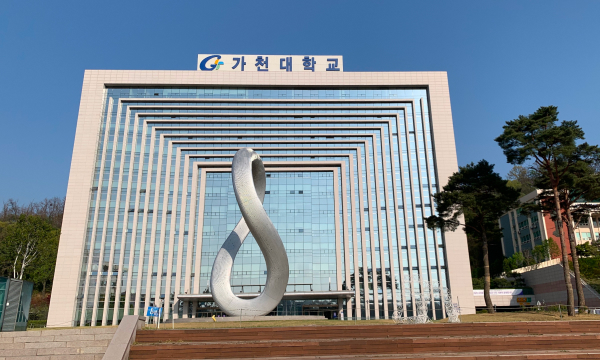
Gachon University
- 1. Research Institution: Department of Chemistry, Gachon University
- 2. Experimental Period: January 30, 2007 – November 30, 2007 (305 days)
- 3. Research Objective: To evaluate whether the PH7.4 purification system can remove harmful substances from tap water and provide the conditions of healthy water.

Experimental Results
- Harmful substances and bacteria were not detected in the control comparison.
- Harmful heavy metals were almost completely removed.
- Mineral preservation was excellent, especially with Pocheon granite.
- Among granite samples, Pocheon granite showed the highest mineral activation effect, with an energy absorption value of 17,540.5 J/g-water.
- It showed a favorable mineral balance, including major minerals such as Ca > Na > Mg > K, similar to natural spring water.
- The water quality was closest to that of natural mineral spring water, and its composition was considered highly suitable for drinking.
- The ionized mineral energy from Pocheon granite was estimated to generate beneficial wave energy in the range of 1.14 × 10¹³ ~ 5.64 × 10¹³ Hz.
- The energy concentrated in the water molecules was estimated at approximately 4.71 × 10⁻²⁰ erg, suggesting efficient energy transfer within the water.
Removal of Rare and Heavy Metals (%) (Measured Concentration: ppb)
| Metal | Water Quality Standard (ppm) |
Raw Water Concentration (ppb) |
Filtered Water Concentration (ppb) |
Removal Rate (%) |
|---|---|---|---|---|
| Cr | 0.05 | 2.13 | 1.94 | 9 |
| Mn | 0.3 | 8.65 | 3.62 | 58 |
| Mo | - | 0.74 | 0.63 | 14.9 |
| Sb | - | 0.68 | 0.15 | 77.9 |
| Cs | - | 0.53 | ≤ 0.1 | 81 |
| Pb | 0.05 | 0.81 | 0.20 | 75.3 |
| W | - | 0.21 | 0.14 | 33 |
| Co | - | 0.13 | ≤ 0.1 | 23 |
| Fe | 0.3 | 0.009 | Tr | 100 |
Sangmyung University
A summary of experimental research analyzing plant growth and vitamin C production under identical conditions using water passed through the PH7.4 purifier, tap water, bottled water, and other comparison samples.
- 1. Research Institution: Sangmyung University, Department of Chemistry & Bio-Campus Research Center
- 2. Experimental Period: June 2010 – September 2010 (2 months, 14 days of growth observation)
- 3. Research Objective: To compare plant growth using different water sources and evaluate how water affects growth
- 4. Comparison Groups: Jinhaeng Water PH7.4, tap water purifier, tap water, alkaline water, bottled water, and bottled mineral water.

Experimental Results
- It was confirmed that Jinhaeng Water PH7.4 (mild alkaline pH 7.2–7.6) had the most positive effect on plant growth.
-
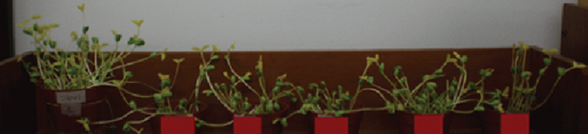
Bean Sprout Cultivation Test - 01 Jinhaeng Water PH7.4
- 05 Reverse Osmosis Water
- 04 Tap Water
- 06 Alkaline Water
- 02 Bottled Water
- 03 Imported Mineral Water
-
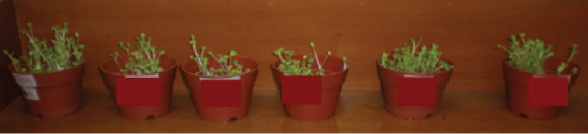
Radish Sprout Cultivation Test - 01 Jinhaeng Water PH7.4
- 04 Tap Water
- 06 Alkaline Water
- 05 Reverse Osmosis Water
- 02 Bottled Water
- 03 Imported Mineral Water
Plant Growth Rate (%)
| Water Source | Bean Sprouts | Radish Sprouts | ||
|---|---|---|---|---|
| Length (cm) |
Growth Rate (%) |
Length (cm) |
Growth Rate (%) |
|
| Jinhaeng Water PH7.4 | 18.8 | 84.0 | 13.1 | 79.8 |
| Alkaline Water | 15.3 | 74.8 | 10.3 | 68.2 |
| Reverse Osmosis Water | 15.4 | 78.8 | 11.4 | 69.6 |
| Bottled Water | 17.3 | 82.0 | 12.1 | 78.4 |
| Imported Mineral Water | 16.6 | 80.4 | 12.0 | 73.8 |
| Tap Water | 16.1 | 79.6 | 12.2 | 72.6 |
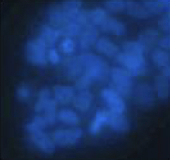
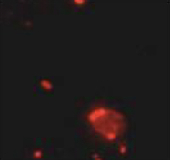
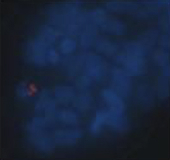
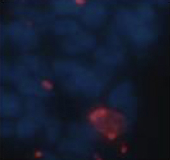
세포 생존율(%)
| Sample | DAY 0 | DAY 2 | DAY 4 | DAY 6 |
|---|---|---|---|---|
| Jinhaeng Water PH7.4 | 100 | 100 | 98.6 | 96.7 |
| A | 100 | 98.4 | 94.0 | 91.3 |
| B | 100 | 100 | 97.6 | 94.2 |
| C | 100 | 100 | 97.7 | 94.1 |
| D | 100 | 100 | 96.2 | 96.0 |
| E | 100 | 98.6 | 94.3 | 95.1 |
| Classification | Jinhaeng Water PH7.4 | A | B | C | D | E |
|---|---|---|---|---|---|---|
| Hoechst33342 |  |
 |
 |
 |
 |
 |
| RFP |  |
 |
 |
 |
 |
 |
| Merged |  |
 |
 |
 |
 |
 |
Korea Environmental Water Research Institute
Results of harmful heavy metal and bacteria removal tests using water passed through the PH7.4 purifier.
| Test Item | Unit | Drinking Water Standard | Results | ||
|---|---|---|---|---|---|
| Influent Water | Effluent Water | Removal Rate (%) | |||
| Mercury | mg/L | ≤ 0.001 | 0.009 | Not Detected | 100 |
| Lead | mg/L | ≤ 0.05 | 0.554 | Not Detected | 100 |
| Hexavalent Chromium | mg/L | ≤ 0.05 | 0.488 | Not Detected | 100 |
| Iron | mg/L | ≤ 0.3 | 0.846 | Not Detected | 100 |
| Aluminum | mg/L | ≤ 0.2 | 0.577 | Not Detected | 100 |
| Copper | mg/L | ≤ 1.0 | 2.9004 | 0.072 | 98 |
- Removes harmful heavy metals such as mercury, lead, hexavalent chromium, iron, and aluminum.
| Test Item | Unit | Results | ||
|---|---|---|---|---|
| Influent Water | Effluent Water | Removal Rate (%) | ||
| Pseudomonas aeruginosa | CFU/mL | 1100 | Not Detected | 100 |
* Analysis Institution: Korea Environmental Water Research Institute
- Pseudomonas aeruginosa count before filtration: 1,100 CFU/mL. After filtration: Not Detected.
Patents & Certifications
-
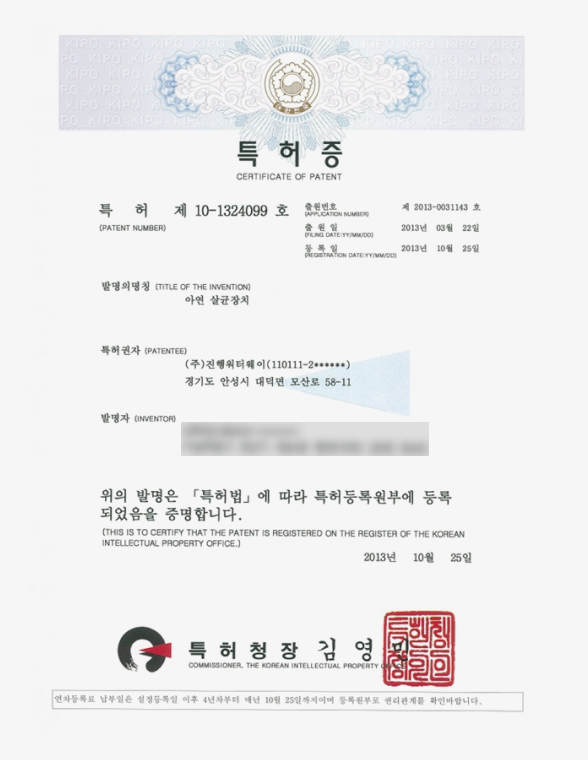
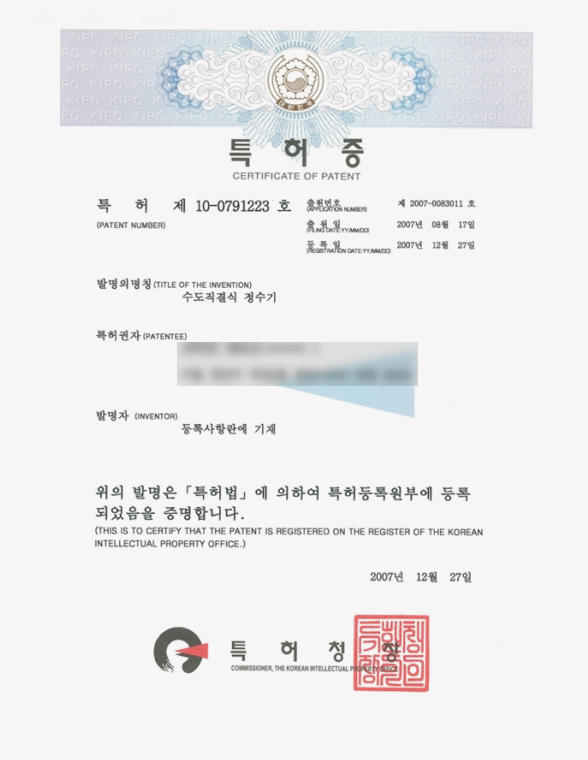
Direct Tap Water Purifier
-
Zinc Ion Generator (Jinhaeng RSI)
-
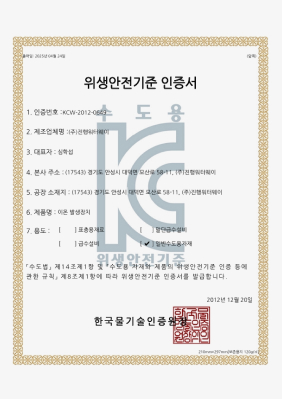
Sanitation Safety Standard
-
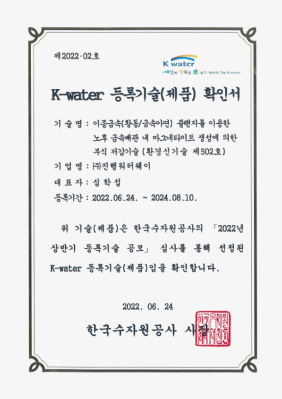
K-water Registered Technology
-
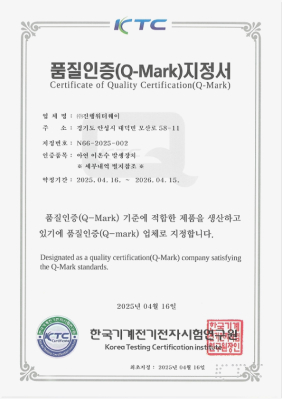
Quality Certification Letter
-
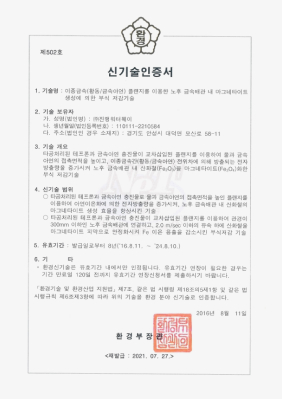
New Technology Certificate